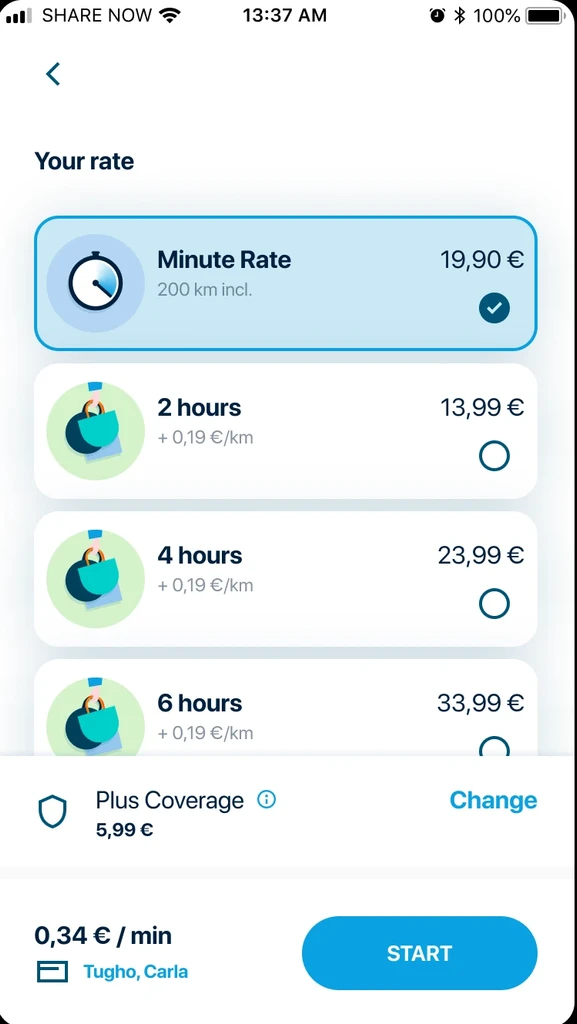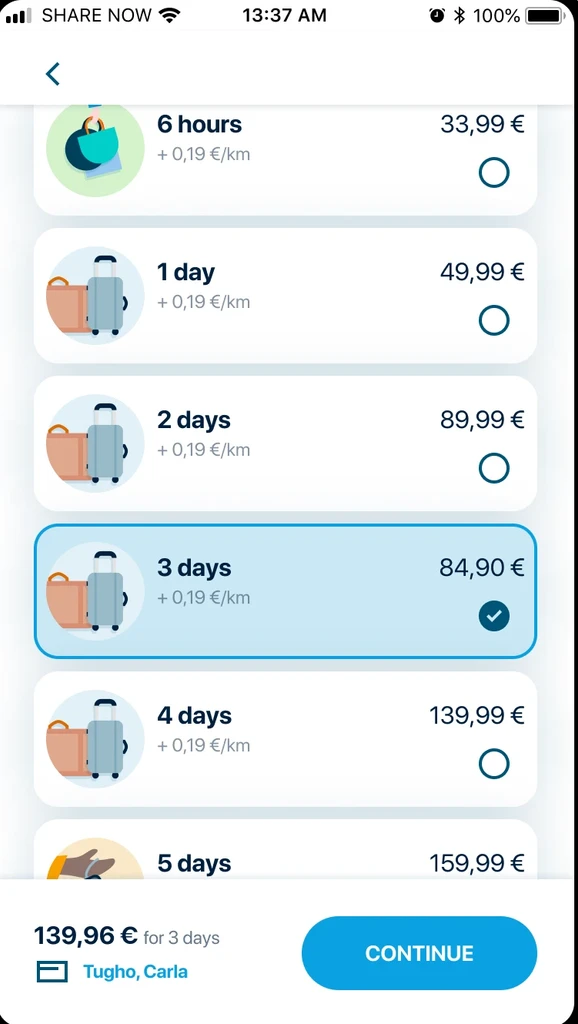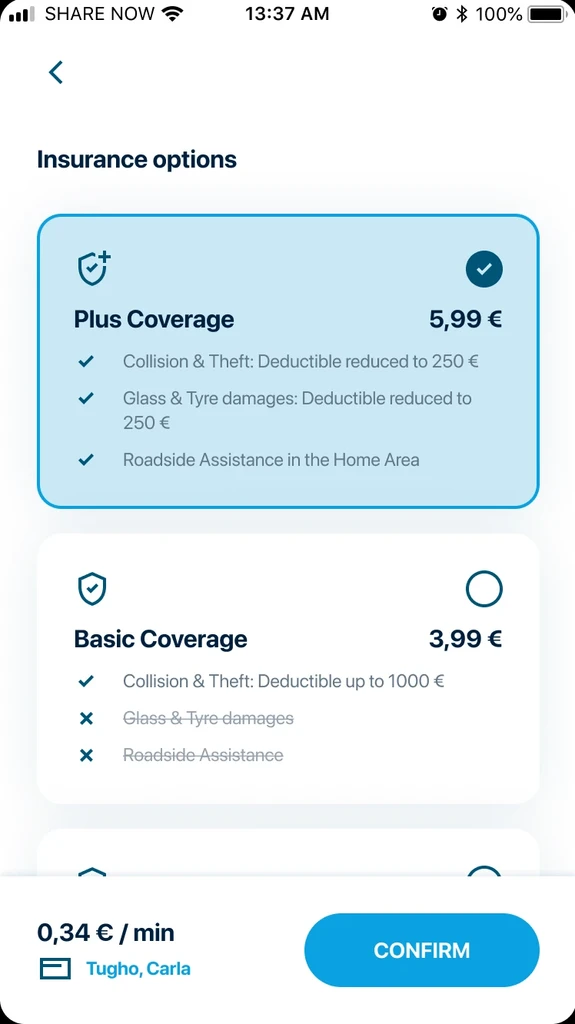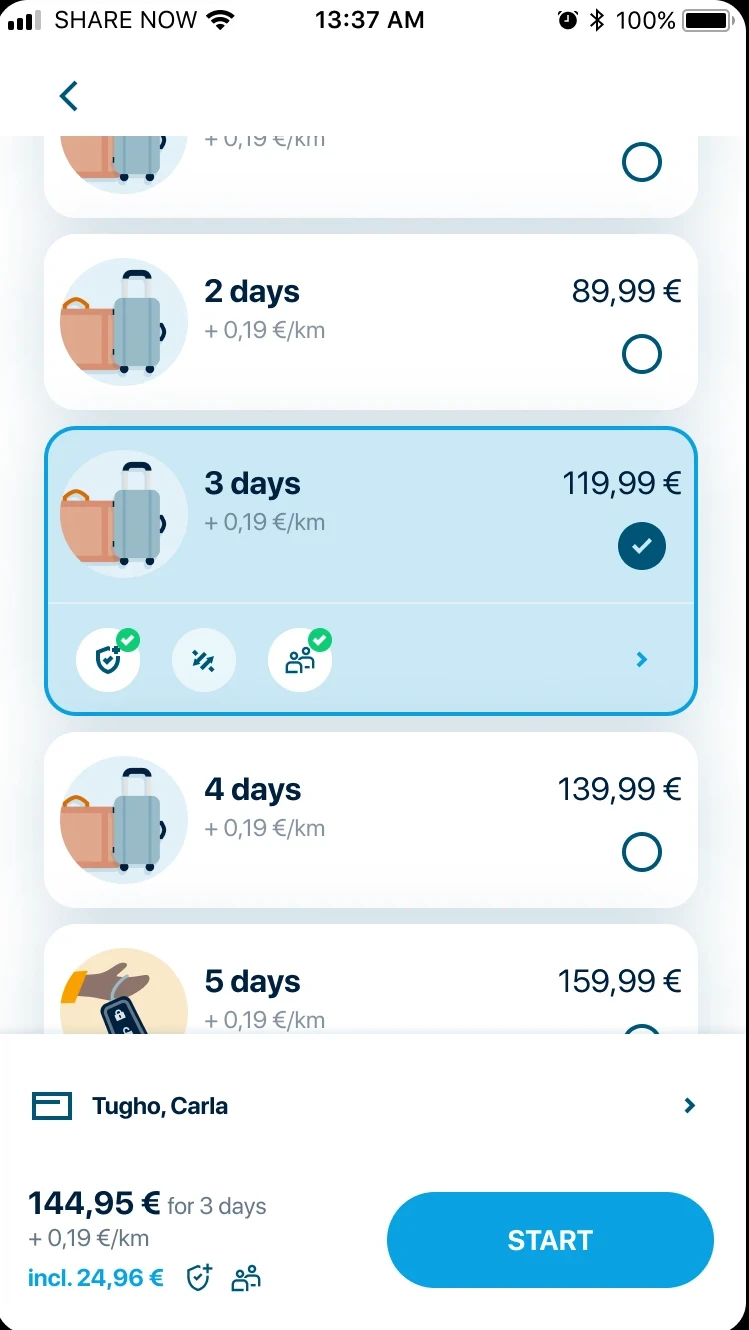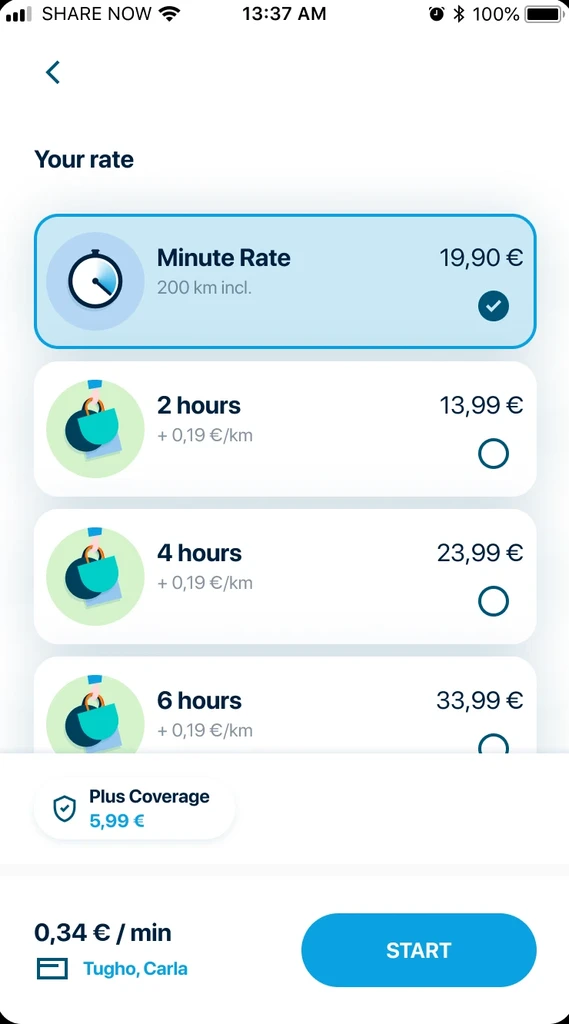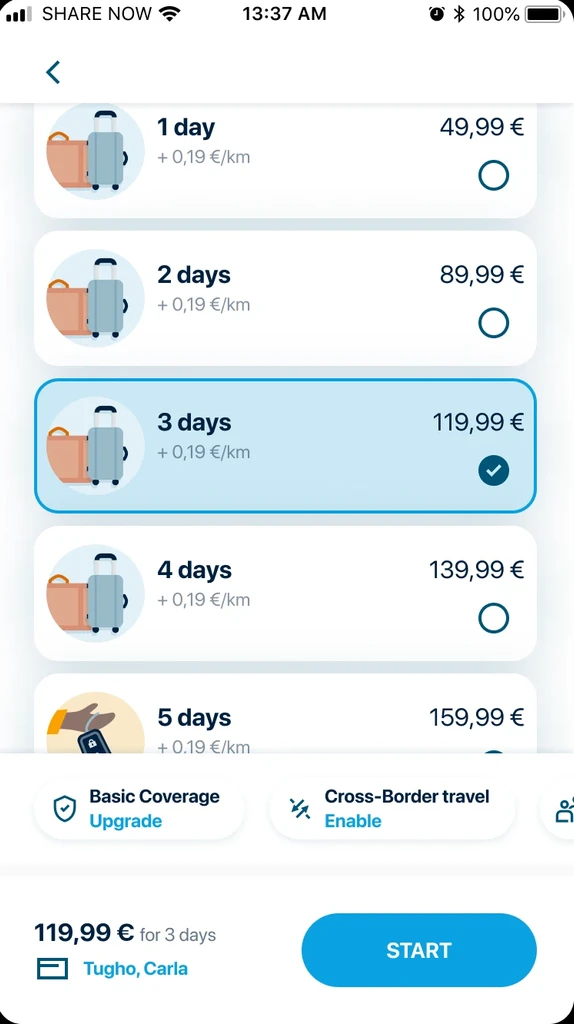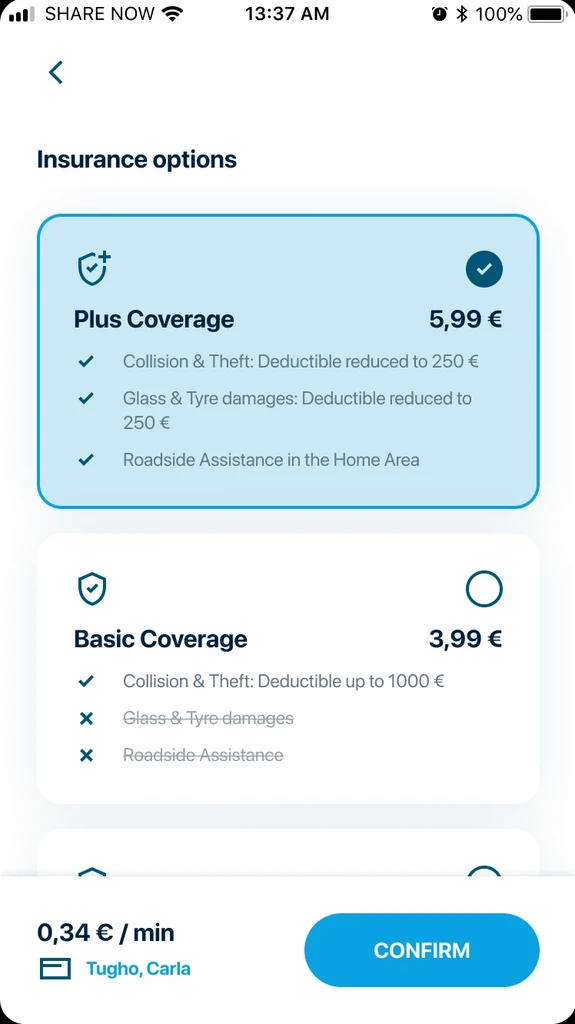
Share Now car rental app showing extras selection flow

Upsell Without Friction

A hybrid extras flow increased revenue on spontaneous trips.

Proving upsells can work without slowing "start rental," and that validating assumptions early matters.

+2.4% increase in extras revenue for spontaneous trips

Share Now · 2020 · 3 Months

UX Concept Wireframes + Prototype Visual Design Stakeholder Management Discovery
Starting Point

Share Now offers two rental modes: spontaneous rentals, where users pick up a car anywhere and start immediately, and pre-booked trips planned in advance. Experiments in the pre-booked flow — offering additional drivers, better insurance, and other extras — had already increased revenue by approximately 8%.

We aimed to capture similar opportunities for spontaneous trips, particularly longer rentals. The question was whether those mechanics could work in a flow built entirely around immediacy.

Goal

Offer meaningful extras for spontaneous car-sharing users without disrupting their primary task of starting a rental, while maximizing potential revenue from longer trips.

Hypothesis

We entered the project with two distinct hypotheses: one behavioral, one about revenue impact. Both needed to hold for the effort to justify its priority.

01 · Behavior

Users on longer spontaneous trips will opt for extras if presented clearly and conveniently.

02 · Revenue

By tailoring and surfacing extras to match trip type, spontaneous rentals will achieve a proportional increase in additional revenue comparable to pre-booked rentals.

Discovery

Comfort and security

I need to feel safe and at ease on longer trips, with clear insurance options, roadside help, and confidence driving in unfamiliar areas.

Frictionless short trips

I need to start a quick commute fast, with any extras optional and unobtrusive so nothing slows down "start rental."

Clarity and control

I need transparent, easy-to-understand extras that scale with my trip type and duration, so I can choose only what's relevant without confusion.

Discovery of longer-trip value

I need to know that longer spontaneous trips are supported and worthwhile, with visible rates and extras that make extended use practical and cost-effective.

Users

Two main user segments with distinct needs. And what "optional" really means differs fundamentally between them.

The Commuter · Minutes – 12 hrs · ~80% of users

Short trips in familiar areas

Get from A to B quickly.
Low risk perception.
Priority: Get a car.

Extras must be optional and non-obstructive. Any friction in "start rental" is a direct cost to this segment.

The Traveler · 1 – 30 day trips · Growing segment

Longer trips in less familiar areas

Temporary car ownership.
Priority: comfort and security.

Extras should provide insurance clarity, roadside confidence, and peace of mind for unfamiliar territory.

Concept

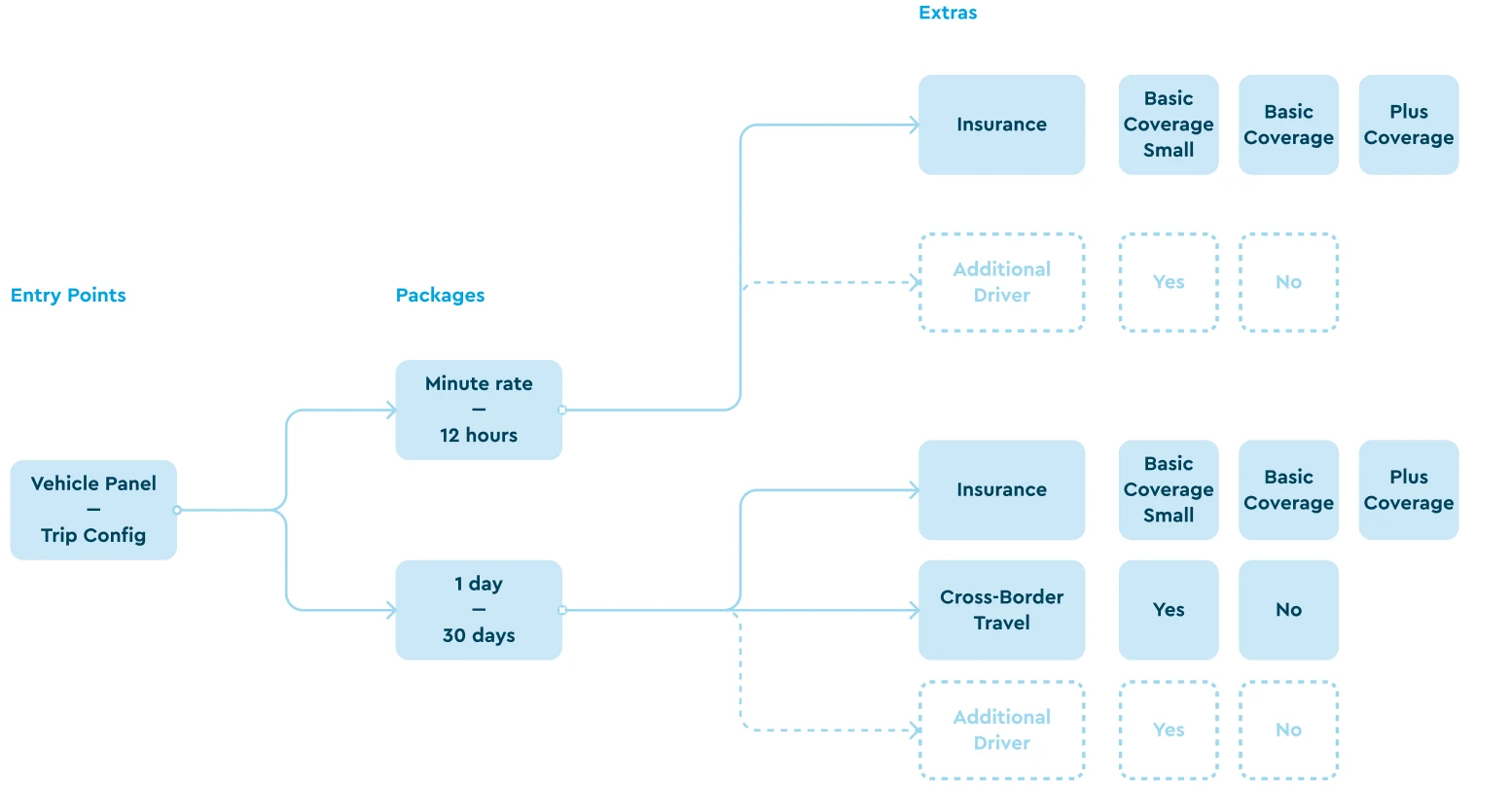
BI insights guided an initial matrix of extras by rate type, designed to scale to future options such as Additional Driver. Based on the data, we defined which extras to offer per selected rate and ensured the designs could support expanding the catalog over time.

Matrix mapping available extras to each rental rate type

Exploration

We created wireframes integrating extras into the existing spontaneous rental flow, collaborating with engineers to ensure feasibility. Three distinct approaches emerged — each with a different answer to where and when to surface extras.

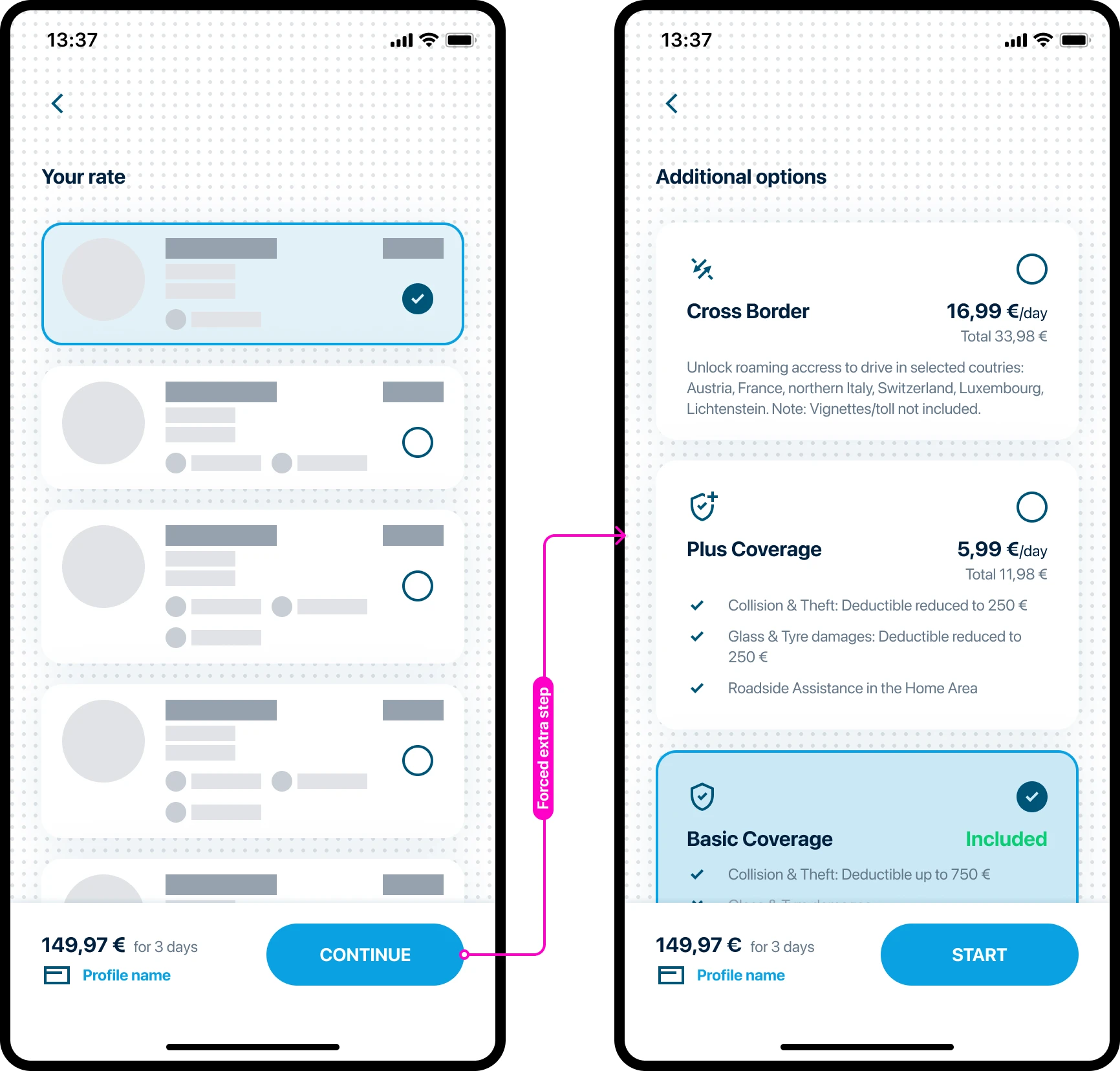
Dedicated Step

Dedicated Step wireframe approach

Pros

  • Prominent
  • Scalable
  • Clear expectation-setting

Cons

  • Forces flow
  • Ignores individual JTBD

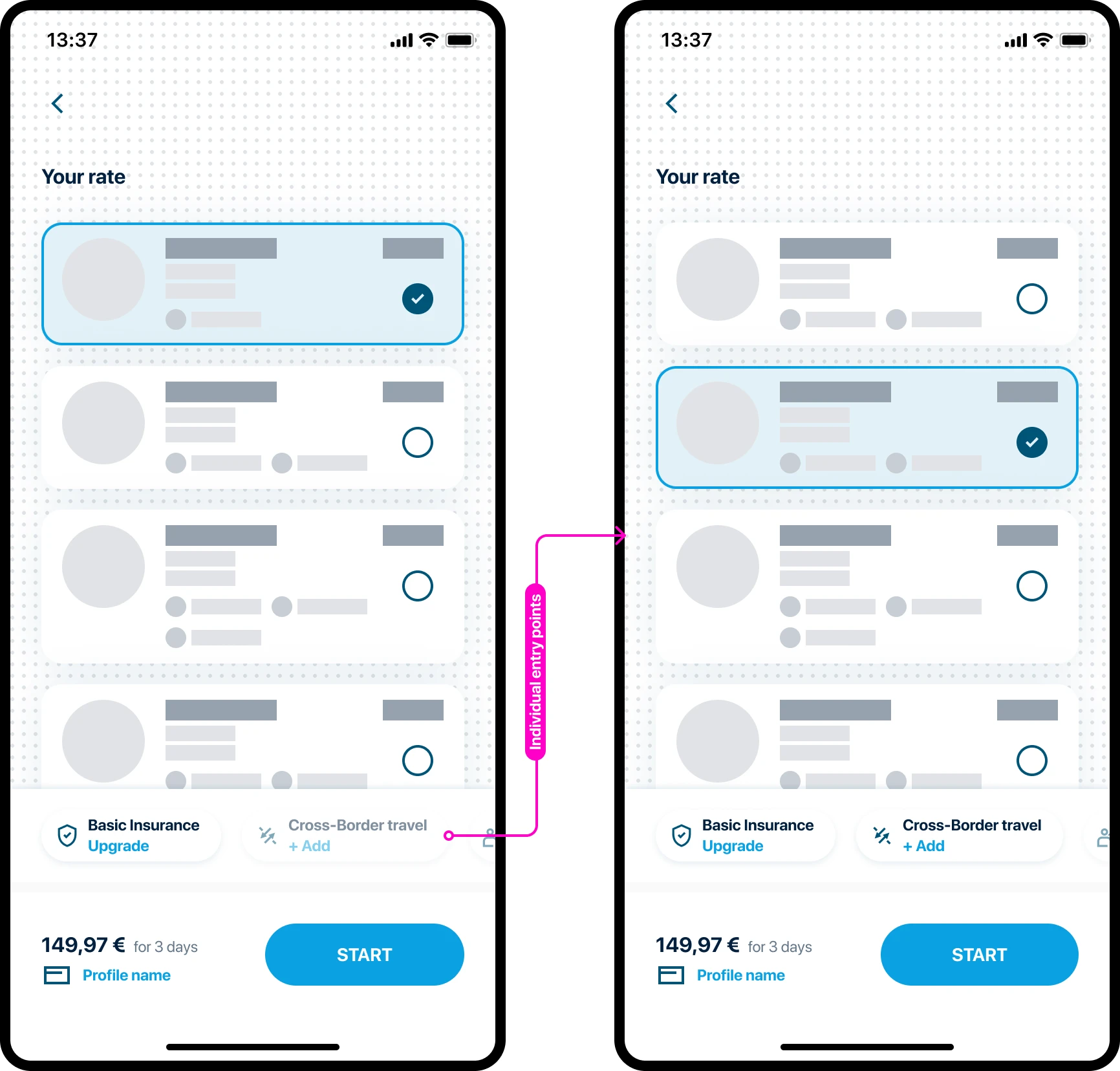
Extras Pills

Extras Pills wireframe approach

Pros

  • Short flow
  • Close to CTA
  • Optional for commuters

Cons

  • Easy to overlook
  • Scales poorly

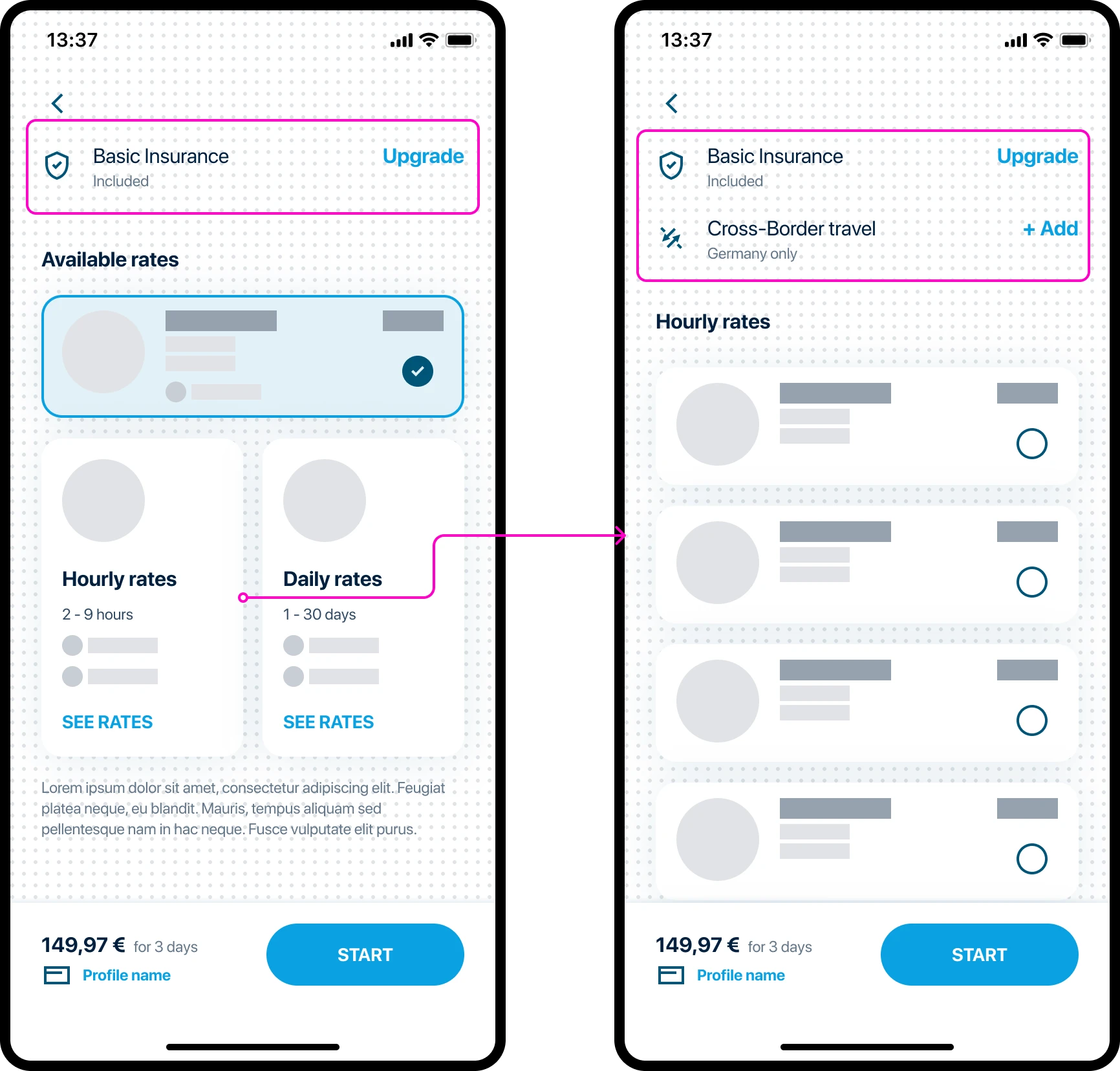
Clustered Rates

Clustered Rates wireframe approach

Pros

  • Short flow
  • Tailored extras per rate cluster

Cons

  • Entry point far from main action
  • Low visibility

User Research

5 in-house participants · 3 heavy users, 1 non-user · 20 min per session · Goal: surface issues with extras discoverability, price transparency, and overall accessibility.

Dedicated Step

Dedicated Step — testing overview Dedicated Step — screen 1 Dedicated Step — screen 2 Dedicated Step — screen 3
Prototype Dedicated Step

FindingsConfusing for minute rentals. Limited cost experimentation.

Extras Pills

Extras Pills — testing overview Extras Pills — screen 1 Extras Pills — screen 2 Extras Pills — screen 3
Prototype Extras Pills

FindingsPreferred. Good task success. Curiosity-driven interaction.

Clustered Rates

Not pursued

Engineers flagged clustering as technically heavier to build. Narrowed focus to Extras Pills and Dedicated Step before user testing began.

Final Design

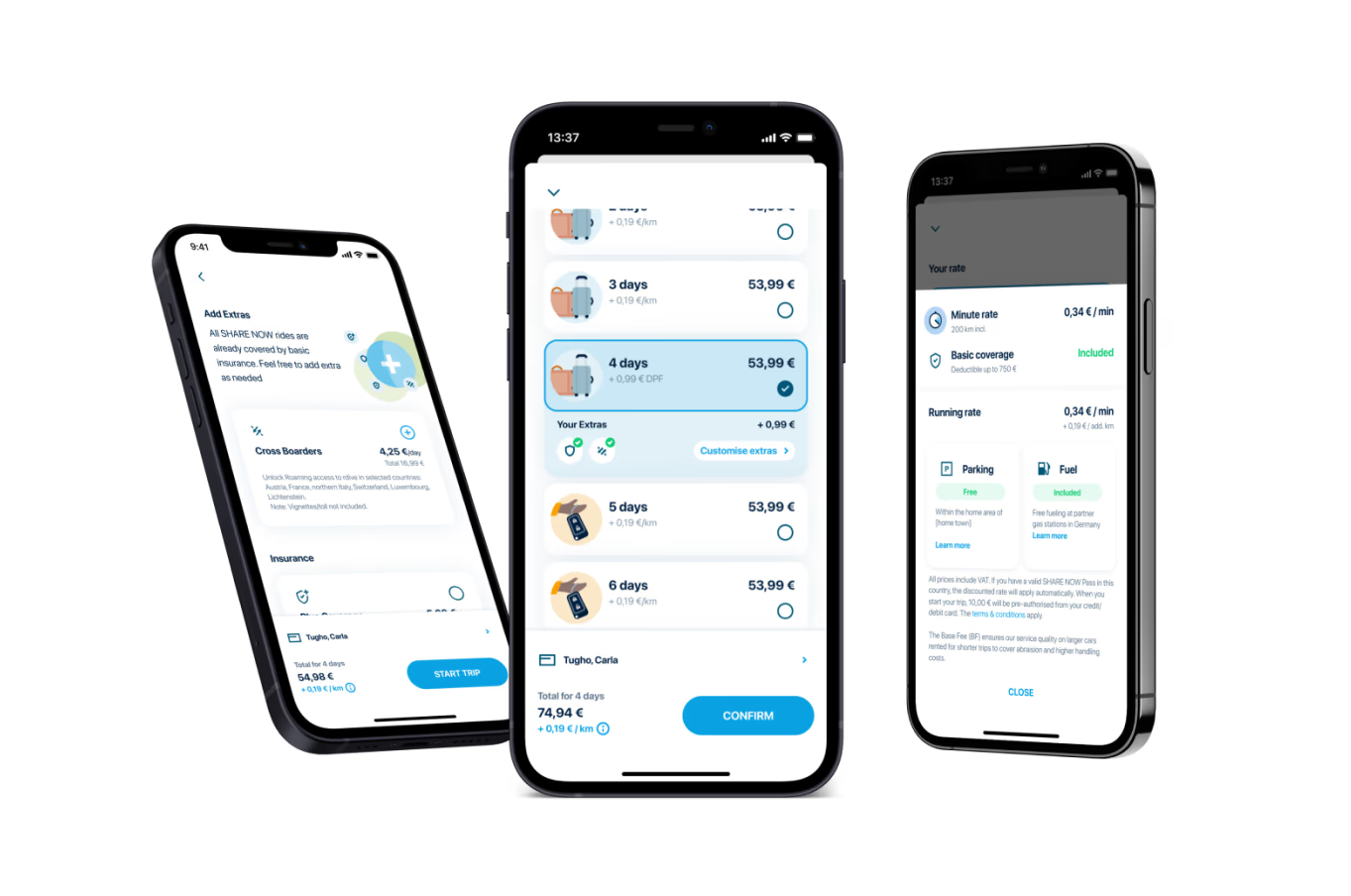
We merged the best aspects: optional extras for short trips with mandatory awareness for longer rentals. Preserving the commuter flow while giving travelers the context to make an informed decision.

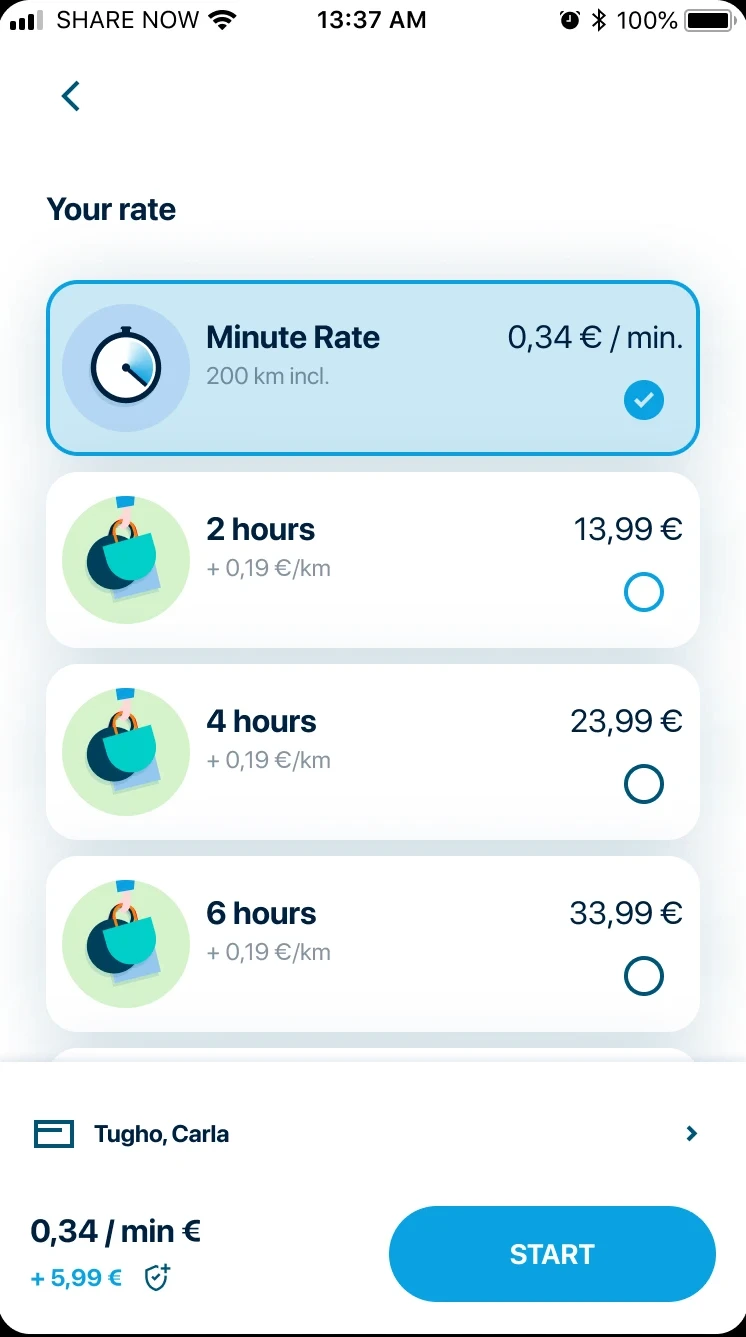
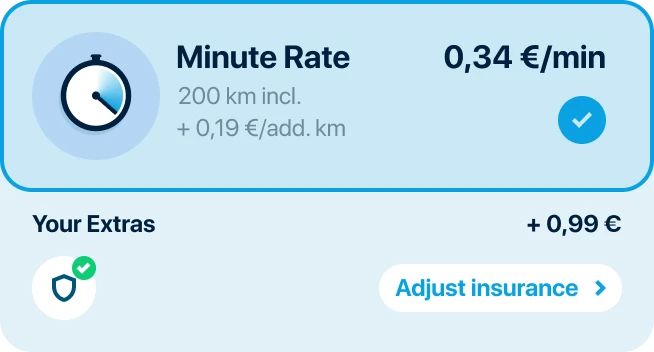
Increased affordance of pills

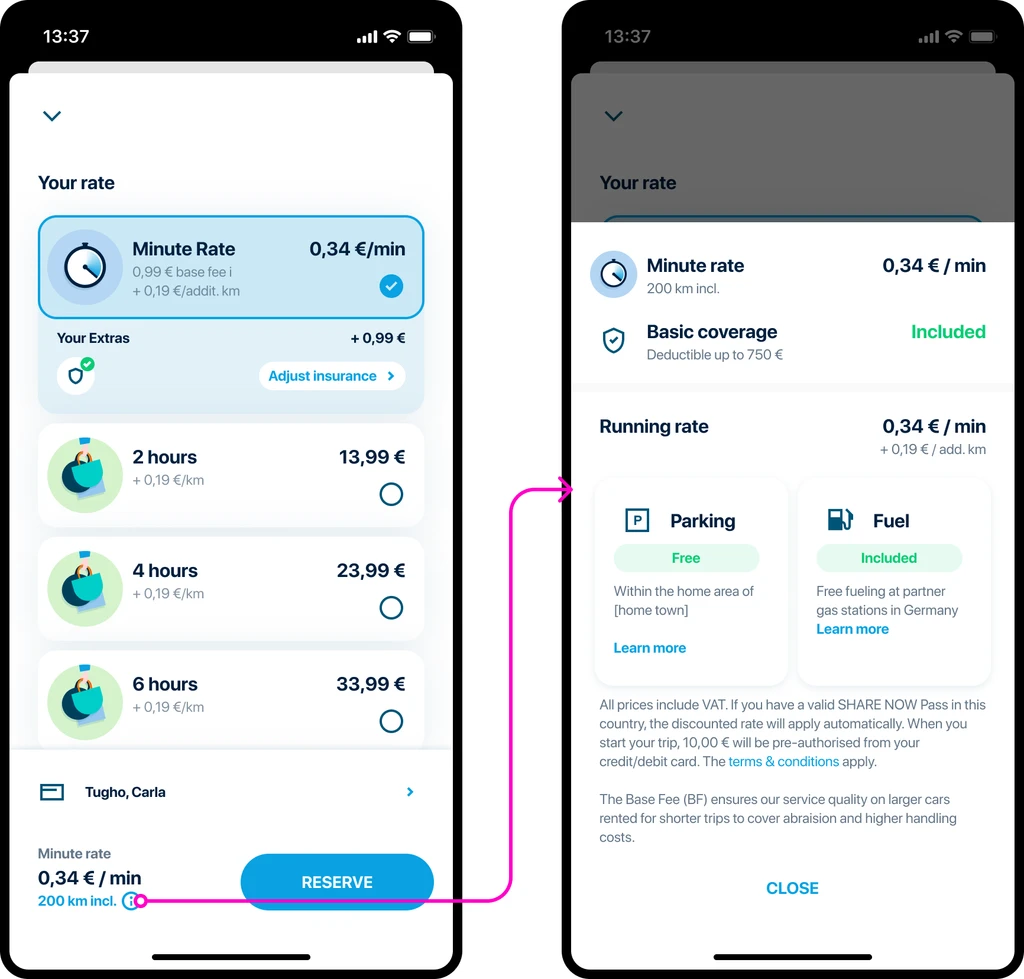
Improved pill affordance with clear calls to action ("Edit options," "Adjust insurance"), an extras subtotal, and a green check mark on selected extras.

Revised extras pills with improved affordance, subtotal, and selection state

Secondary action

Added transparency of costs and driving rules.

Secondary action surface showing cost transparency and driving rules

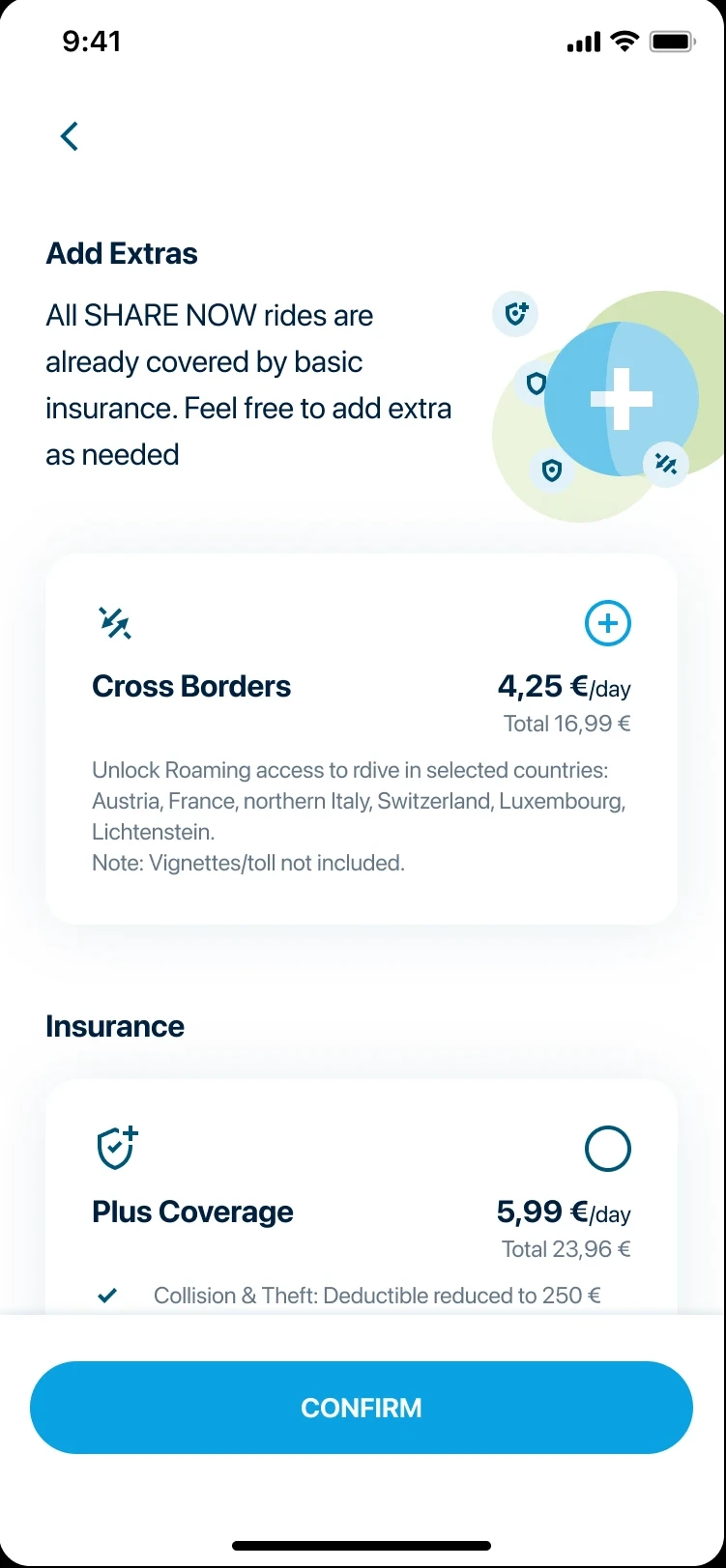
Proper stage for "Your extras"

Enough room to explain extras.

Dedicated extras stage for longer rentals with full explanation space
Final Prototype Upsell Without Friction — Production-ready flow

Outcome

~2.4% increase from extras, mainly insurance upgrades. Lower than the ambitious target due to short duration of most spontaneous trips.

We expected upsell gains from spontaneous trips to mirror pre-booked rentals, but early data showed spontaneous trips are much shorter on average, naturally limiting upsell potential. Regardless of how well the UI works, the structural constraint was the trip length distribution.

+2.4% increase in extras revenue Mainly from insurance upgrades
~8% target not met. Pre-booked benchmark for extras revenue added per trip. Spontaneous trips are structurally shorter, limiting upsell potential

Key Take-Aways

We expected upsell gains from spontaneous trips to mirror pre-booked rentals, but early data showed spontaneous trips are much shorter on average, naturally limiting upsell potential.

Assumptions from pre-booked rentals inflated expectations. Small gains still matter in absolute revenue. Validate in the problem space before solutioning to avoid overestimating impact.

Next Case Study

Increasing Customer Loyalty

↑ Revenue +10% · Higher adoption post visibility improvements

View case study →
Increasing Customer Loyalty case study thumbnail